"It wouldn't have really been possible in its actual form any other way."
Dr Philip Newall, Senior Lecturer in Psychology, University of Bristol
Ella Goldstein asked 32 people who bet on sports to screen-record their favourite betting app and talk through what they saw. The dissertation was marked at 84%, a high First that no student in her year bettered, carried Ella to the Outstanding Achievement Award for the top overall grade in a cohort of about 200, and is now a manuscript under full consideration at a top journal in the addictions field.
"It wouldn't have really been possible in its actual form any other way."
Dr Philip Newall, Senior Lecturer in Psychology, University of Bristol
The full story of how an undergraduate dissertation budget produced novel findings on dark patterns and the defences gamblers build against them, and what the method looked like session by session.
Share it with any supervisor whose students have ideas bigger than their budgets.
Dr Philip Newall is a senior lecturer in gambling psychology at the University of Bristol, and one of very few researchers who has seen the industry from the other side of the table: before academia, he was a professional poker player. His 2025 paper mapping dark patterns in online gambling inspired final-year psychology student Ella Goldstein, who put him top of her supervisor list and arrived with an idea of her own.
The field had a methodology problem. Gambling companies do not share platform data with their critics, so researchers audited the apps themselves, counting clicks and cataloguing suspect features. Two blind spots come built in: researchers may fixate on features that do not actually influence anyone, and miss the ones that do. Interviews add recall bias and social desirability. Ella wanted real bettors, inside their real apps, thinking aloud as they went.
"It's a great research skill, actually… being bold enough to ask."
Dr Philip Newall, University of Bristol
The method was think-aloud: each participant screen-recorded themselves navigating their preferred sports betting app on their own phone, in their own time, narrating what they saw and did, guided by written prompts. Promotions, Bet Builder, cash-out: the interface itself became the stimulus, and participants led the way to what actually mattered.
Ella built the study herself, with no programming background, and screened carefully: 18 or over, active in sports betting within the previous twelve months, and below the threshold for gambling harms. Seventy-four people entered screening, 55 met the criteria, and 32 completed the full study, all of them, as it turned out, men. Nobody placed a bet during a recording. Every response arrived transcribed and stored chronologically, so the analysis kept pace with fieldwork.
The dark patterns came as hoped, including some the literature had barely touched: immediacy cues, deep-scroll tactics. The surprise ran the other way. These recreational bettors had built their own guardrails, unprompted: betting only on their own team, only on matches they already planned to watch, only in small amounts to sharpen the watching. No researcher-driven audit could have found that, because no audit thinks aloud.
"They weren't using the apps to bet on, say, like, second division Brazilian football or something… They were betting on their team, or say, like, betting on England, and like these were matches they wanted to watch."
Dr Philip Newall, Senior Lecturer in Psychology, University of Bristol
"The narrated screen recording tool offered by Qualzy was perfectly suited to the study as it enabled participants to scroll through the apps in a naturalistic way while narrating aloud their experiences."
Ella Goldstein, University of Bristol
Qualitative research carries a tax: transcription takes at least three times as long as the recording it serves, by Philip's reckoning, and he has watched a co-author hand-type a 240,000-word corpus on a previous interview study. Ella, working independently, put it at 45 minutes to an hour per recording. Across 32 recordings, at least 30 hours. Qualzy's automatic transcription paid that tax for her, and the transcripts arrived readable.
The hours went where they earn marks: into the analysis. The main themes were already emerging by the fifth session, and because responses landed in one chronological feed, Ella analysed as the fieldwork ran. Participants, most of whom had never screen-recorded anything, were pleasantly surprised at how simple the task was.
"I don't think our sample size would have been feasible within the context of an undergraduate dissertation without effective auto transcription."
Dr Philip Newall, Senior Lecturer in Psychology, University of Bristol
"It made the process far more efficient and gave me more time to get stuck into the data and deepen my analysis."
Ella Goldstein, University of Bristol
"Ella's project is one of the few that I find myself excitedly telling people about."
Dr Philip Newall, Senior Lecturer in Psychology, University of Bristol
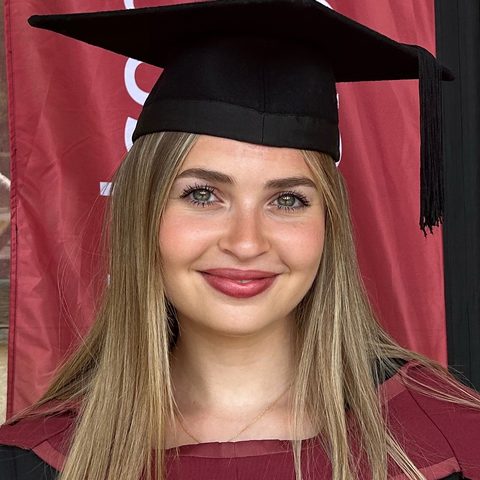
"Qualzy was a valuable learning experience that allowed me to combine creativity with new technology to collect rich qualitative data that suited my unique research aims."
Ella Goldstein, BSc Psychology, University of Bristol