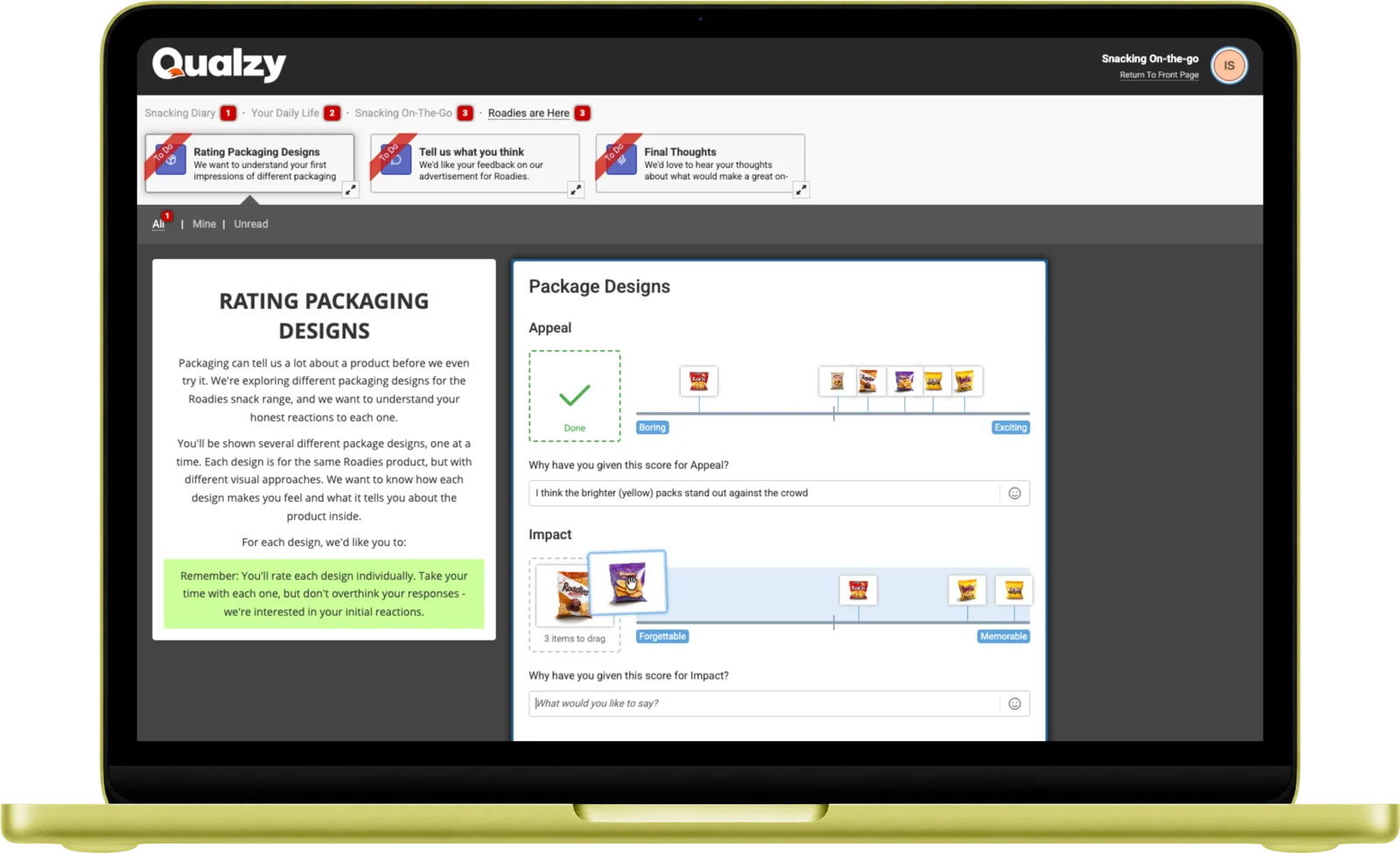
Rate items across multiple criteria: drag cards onto scales, see where they sit relative to each other, and add the reasoning behind every score. Ranked comparison with depth: the numbers tell you what wins; the reasoning tells you why.
How it works
Researchers create a set of cards (products, concepts, brands, messages, or any stimulus) and define the criteria each card will be rated on. Criteria can be anything: appeal, relevance, uniqueness, likelihood to purchase, fit with brand, and so on.
Cards are presented in a pile. For each rating scale (appeal, relevance, fit with my life, and so on), participants drag each card to its position along the scale, seeing where they've already placed other cards as they go. Each dimension is worked through in turn.
Qualzy calculates mean and median scores per card across all dimensions, enabling direct ranked comparison across the full set. Results are available per participant and aggregated across the sample, with visualisation tools to surface the patterns.
Participant experience
Participants see the full card set in a pile and work through each rating scale in turn, dragging cards to their position, with other cards already placed visible for comparison. The visual format makes scoring intuitive and comparative.
After each scale, participants can add open-ended reasoning explaining their placements, so researchers get the number and the story behind it in a single activity, without a separate follow-up.
Participant accesses Card Score via a link on any device: mobile, tablet, or desktop. No app to install.
Sees the full card set (text, images, or both) before beginning to place them on the first rating scale.
Places each card on the rating scale for the first dimension: appeal, relevance, or whatever the researcher has defined. Cards already placed are visible, enabling comparison.
Optionally explains their placements for that dimension, why certain cards rated high or low, what they noticed. Captured per scale alongside the scores.
Works through each rating dimension in turn. Qualzy calculates mean and median scores per card across all scales once complete.
Results & analysis
Card Score produces mean and median scores per card across every dimension, with participant reasoning captured alongside. Maizy Chat lets you interrogate that reasoning conversationally at any point during or after fieldwork.
Scores & Rankings
Qualzy surfaces the ranked output automatically, which concept or product scored highest on each dimension, how scores vary by segment, and where the largest gaps between items appear.
Open Reasoning
Participants add open-ended reasoning alongside their scores for each dimension, explaining why certain cards rated high or low and what drove their placement. All reasoning is captured verbatim and available to review per participant or across the full sample.
Maizy Chat
Use Maizy Chat during or after fieldwork to interrogate the dataset: "What drives high appeal scores for Concept A?" or "Why do participants rate Concept C low on relevance?" Conversational queries across the full sample's reasoning.
Reporting
Card Score rates every item across as many criteria as the study needs: appeal, premium feel, relevance, purchase intent, or anything else. Each criterion gives you an individual ranked score.
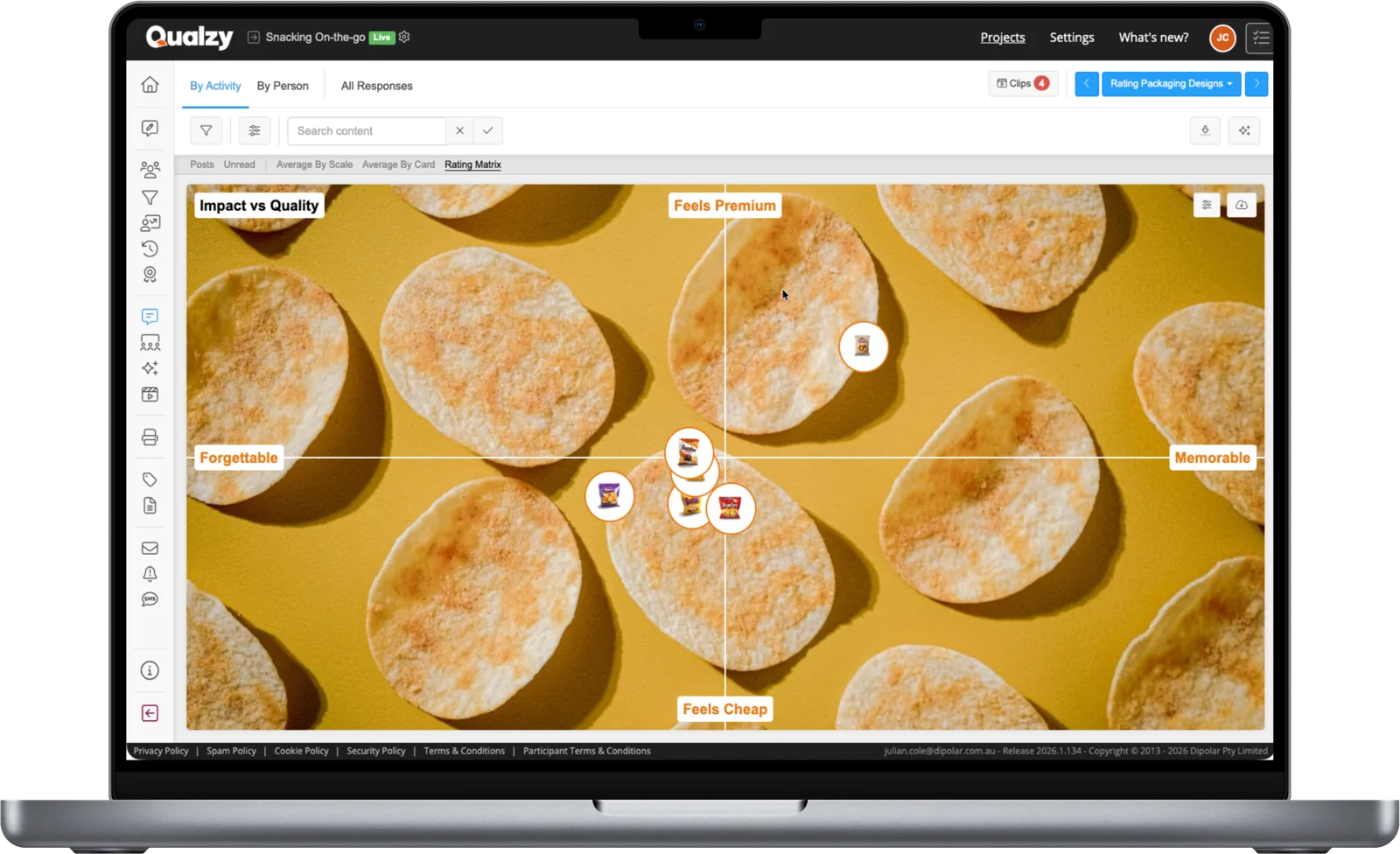
The reporting goes further: pick any two of those criteria and Qualzy plots all rated items in a two-axis matrix. Change either axis and the view updates immediately, so you can explore every possible two-way comparison without any pre-defined grid. Appeal versus premium feel. Relevance versus uniqueness. Likelihood to purchase versus brand fit. The same scores, infinite perspectives.
Use cases
Test multiple product or service concepts simultaneously, scoring each on appeal, relevance, uniqueness, and purchase likelihood. Qualzy produces a ranked output with the reasoning behind every score, giving clients a defensible recommendation rather than a preference vote.
Rate advertising concepts, slogans, or campaign messages across dimensions such as clarity, emotional resonance, brand fit, and motivating power. Identify which message lands, and understand which element of the brief it nails or misses.
Score pack designs on shelf standout, premium perception, information clarity, and purchase intent. Multi-criteria scoring surfaces where a design excels and where it loses people, moving beyond "which pack do you prefer?" to "what's driving that preference?"
Rate a set of brands across attribute dimensions: innovation, trust, value, quality, accessibility. Map where each brand sits in participants' minds across multiple measures, and identify white space or competitive vulnerability.
15-Minute Discovery Call
Tell us about your research. You'll have a clear picture about how Qualzy could work for you by the end of the call.
Combine Card Score with these for richer concept and preference research
Activity Type
Card Sort
Reveal how participants naturally organise items into categories, for mental model and category structure research alongside scored evaluation.
Activity Type
Video, Audio & Image Uploads
Pair scored concepts with rich video or audio responses, giving participants space to articulate reasoning beyond the scoring interface.
Activity Type
Pin Task
Annotate pack or concept visuals with pinned comments, capturing spatial reaction data alongside Card Score evaluations.