Ideation combines idea generation and evaluation in one activity. Participants submit ideas independently in a blind first round, so nobody anchors on anyone else's thinking, then vote on the strongest in a second round, giving a reason for every vote.

How it works
In the first phase, participants generate ideas without being able to see what anyone else has submitted. This avoids the anchoring that pulls a group brainstorm towards the first idea, so you see the full range of thinking, including the unconventional ideas that can get lost in a room.
Once the moderator has reviewed the submitted ideas, participants enter a rating phase where they can see all ideas and distribute a limited number of up and down votes. Every vote needs an explanation, so researchers see what participants think is best and why: forced prioritisation with the reasoning behind it.
Once voting closes, every idea has a net score, total positive points minus any negative votes. The ranked output is immediate: no manual sorting, no subjective moderator call. The strongest ideas rise to the top on their own merits.
Participant experience
Participants receive a brief, a stimulus, or a creative prompt, and respond with their ideas in their own time. Text is the default, but they can add video, audio, or images to bring an idea to life in ways that text alone cannot.
Because they respond asynchronously, each participant thinks independently. There's no dominant voice in the room. No one anchors on the first idea raised. The full range of consumer thinking is captured.
Participant gets a task invitation with a stimulus: a question, image, trend, or creative provocation to respond to.
They submit their ideas in text, video, or audio, without seeing what any other participant has submitted.
The moderator reviews submitted ideas before releasing them for rating. Participants then see all ideas and distribute a limited number of up and down votes, explaining the reasoning behind each one.
You can comment on any idea submission to probe the thinking, ask for elaboration, or push the idea further.
Rating phase
Once the moderator has reviewed submissions, the rating phase opens. Every participant sees every idea, and distributes a fixed pool of points across the ones they value most. The net score ranks everything automatically.
Each participant gets a set number of points to distribute, say 10 total. They can give any single idea between +1 and +5, however they like, until their pool runs out.
Participants can also be given a small number of negative votes, typically one −1, to flag an idea they strongly oppose. Both the negative allowance and maximum positive per idea are set by the moderator.
The net score for each idea is total positives minus total negatives. Ideas are ranked automatically, the strongest ideas rise to the top, the weakest sink. No manual sorting required.
Idea being rated

Votes coming in


Use cases
Put consumers inside the innovation process early, before ideas have been developed and invested in. Capture the full diversity of consumer thinking, including the unconventional ideas that agency teams wouldn't reach alone.
Brief participants on your brand challenge and ask them to generate campaign concepts, slogans, or messaging directions. Then use a second phase to build the strongest ideas into something more developed.
Replace the logistics and limitations of a physical co-creation workshop with an async Ideation activity: a larger group, no anchoring and no travel.
Ask customers what features they wish existed, what problems they'd solve, or what a better version of your product would look like. The ranked net score output gives you a clear prioritisation to act on.
Combine Ideation with these to build richer study designs
Activity type
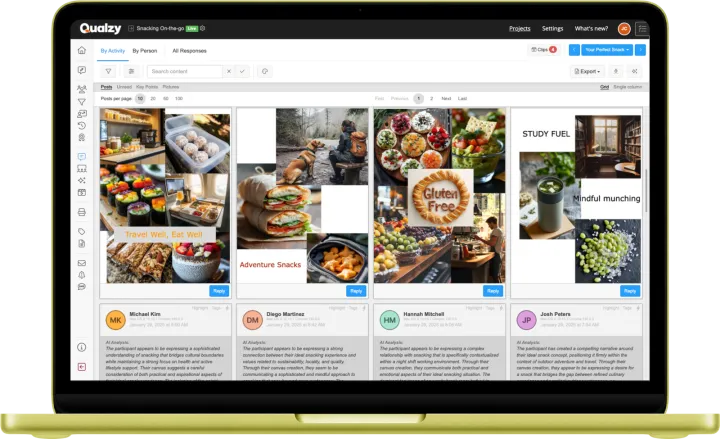
Personal Canvas
Visual ideation through mood boards, image selection and matrix placement, for creative thinking that direct questions don't reach.
Activity type
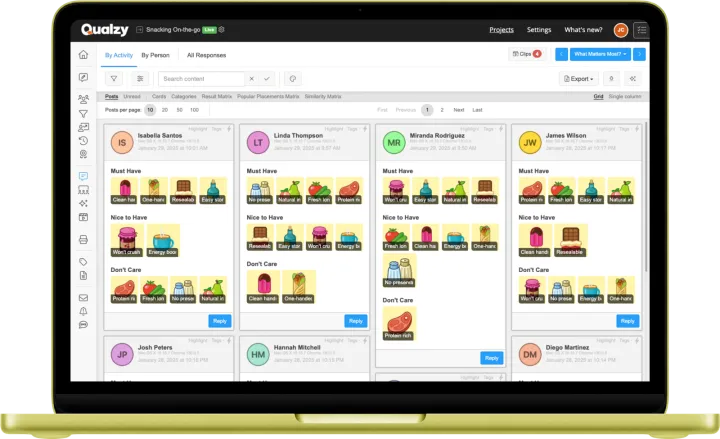
Card Sort
Participants group ideas or concepts in their own way, useful for seeing how they organise the output of an ideation round.
Activity type
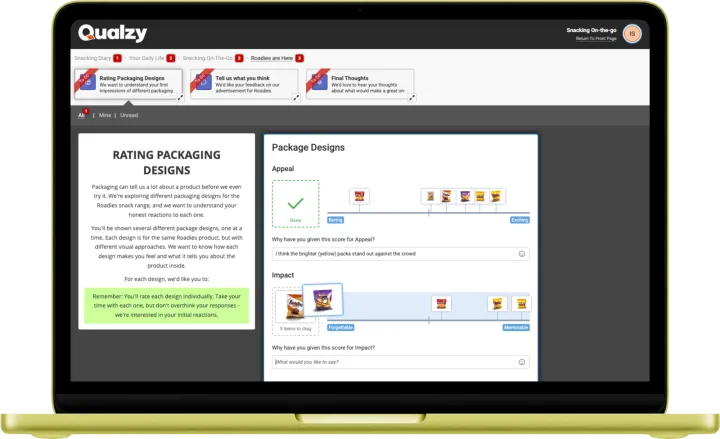
Card Score
Rate ideas on a scale, quantitative prioritisation alongside open qualitative feedback on the strongest concepts.
15-minute Discovery Call
Tell us about your research. You'll have a clear picture of how Qualzy could work for you by the end of the call.
