
Routines and habits
Meals, commutes, the morning rush, a weekly shop. Anything that happens repeatedly is easy for memory to flatten. An entry each time it happens shows the variety, and the photos show the fridge, the shelf and the mess afterwards.
Diary and usage studies
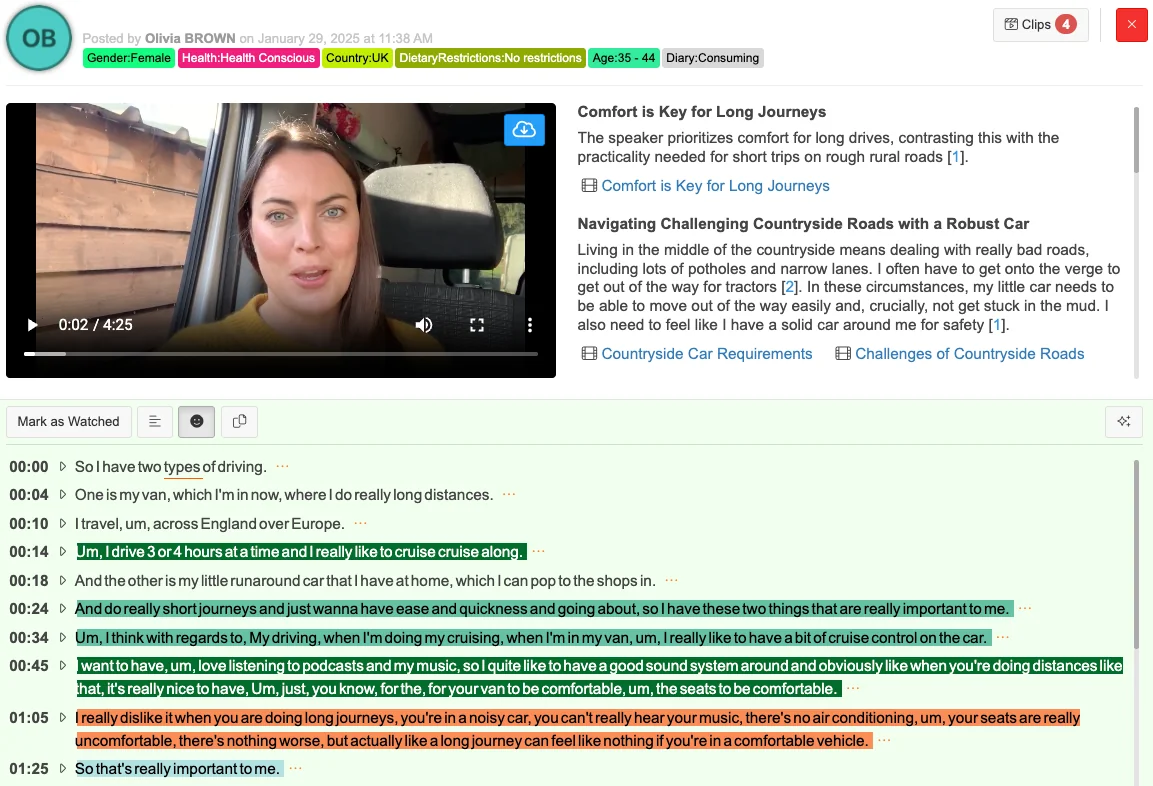
An online diary study asks people to report close to the moment, in text, photos, video or audio, over days or weeks. On Qualzy you see what they actually did rather than what they remember doing, with the routines and attitudes behind it, and every entry is summarised as it arrives.
Meals, commutes, the morning rush, a weekly shop. Anything that happens repeatedly is easy for memory to flatten. An entry each time it happens shows the variety, and the photos show the fridge, the shelf and the mess afterwards.
Screener data, attitude scales and open answers in one project, so the numbers and the reasons sit side by side. Ask about specific occasions rather than behaviour in general, and you get moments instead of self-image.
A few days of entries before an interview or group, so you walk in already knowing how people live. Discovery Research run short projects of one to two weeks this way, ahead of in-person groups and IDIs.
An illustrative example rather than a real participant, but a familiar pattern. Asked on day one, Sam would probably have said breakfast happens most days.
Toast, eaten standing up. The kids' lunches came first.
Here's the cupboard. The cereal's for them, the granola's mine.
Skipped it. Meeting at eight, so just a coffee on the way in.
Breakfast bar from the station kiosk. Not proud of it.
Bacon roll. Friday rule.
Everyone at the table for once. This is what I wish weekdays looked like.
Reading my week back: I sat down to eat twice.
What the week shows. By Sunday, reading back over their own entries, Sam had noticed the pattern too. The gap between the routine people describe and the one they actually live is what a diary is for.
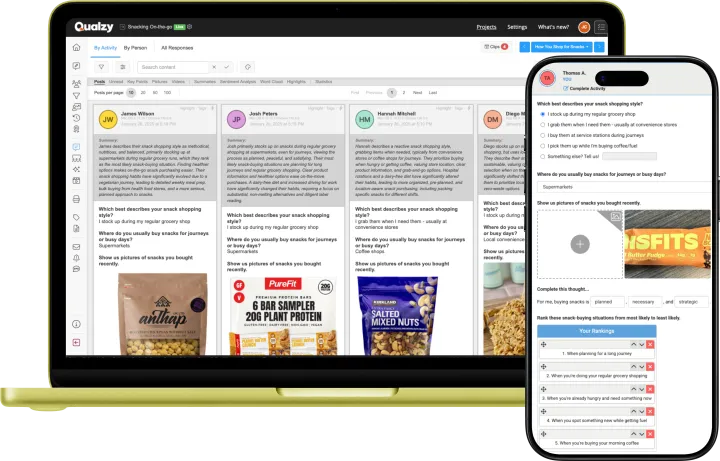
Repeated entries, once a day, once a week or each time something happens, for days, weeks or months. Keep the core questions the same each time so entries can be compared, mix scales with open questions about why, and let people look back at their own previous entries. Forms add survey-style structure, with conditional logic and screener data, inside the same project.
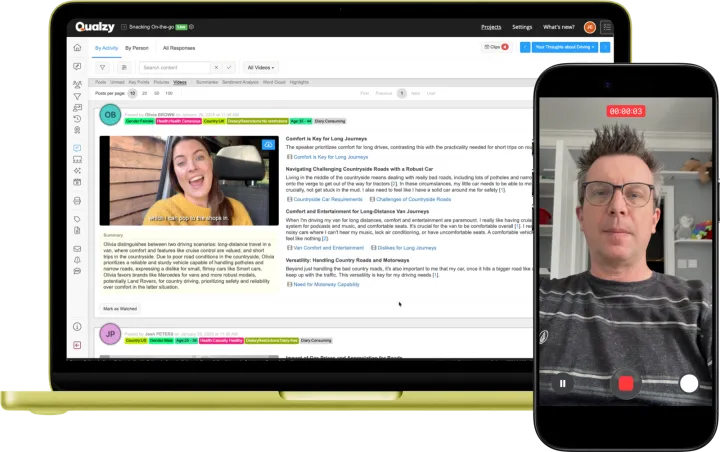
Photos are the workhorse of an online diary, and video adds explanation and feeling. Every video and audio upload is transcribed and summarised as it arrives.
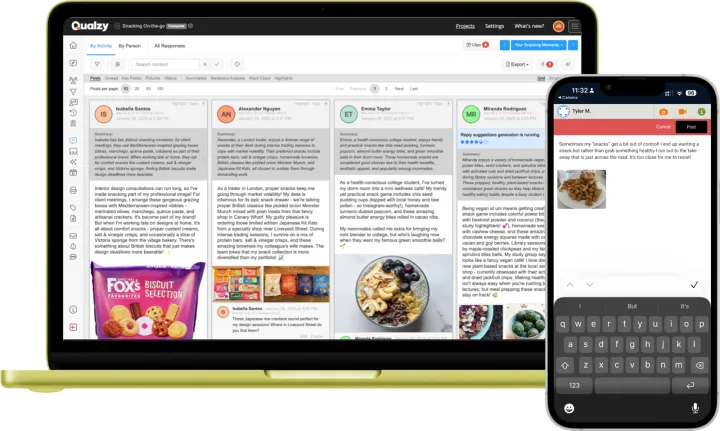
Text, photos, video and voice notes in one response, posted from real situations: at the supermarket, while cooking, after using a product. Posts can be private, or open for comments.
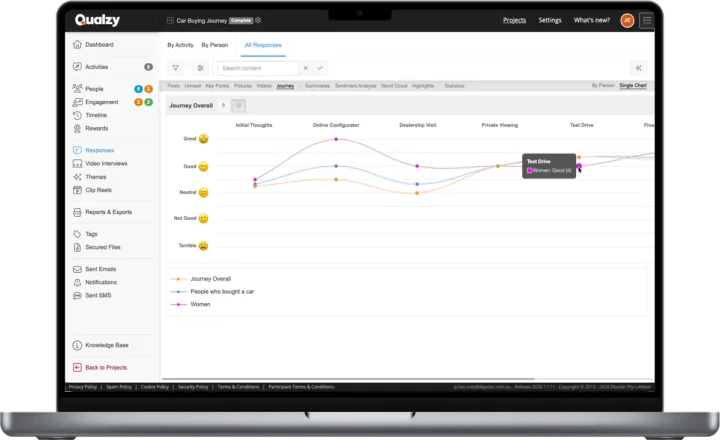
When the experience has stages, such as moving house, choosing a mortgage or recovering from an operation, a journey activity adds a score at every stage. The journey chart shows where things rise and fall, and the entries explain why.
Automatic reminders keep people on track, so you're not chasing them by email on day three. Check who's up to date each day and contact anyone falling behind while there's still time to catch up.
People take part in a browser on their phone, tablet or computer, with nothing to install, so they can make an entry where the behaviour actually happens.
Diaries run in the familiar forum, or as their own self-contained chat with multiple entries, where an AI moderator follows up against the goals you set, asking for the detail that's missing or a better photo.
Most diaries run for one to four weeks as a Qualzy Discussion. For a longer view with the same people, run them in a Qualzy Community.
"We used to ask for input in pre-tasks and get them to email things. Now it is all captured in one place inside Qualzy."
More on designing a diary in our guide to online diary studies.
Usually one to four weeks. Choose the shortest length that gives you enough occasions of the behaviour per person to see a pattern.
Usually, so nobody adjusts their account to match what others have posted. You can open a separate discussion task later if you want people to react to each other.
Yes. The diary runs as its own chat with multiple entries, and the AI moderator follows up against the goals you set. You can also run it as a forum, the familiar way.
Yes. Run the diary as a pre-task, then hold the interviews in Qualzy Live, in the same project, so the diary and the interviews are analysed together.
Yes, whether the diary runs as a forum or a chat. Looking back over a week of their own entries often prompts the most reflective answer of the study, so it's worth asking for one at the end.
The behaviour, who does it and how often. We’ll suggest how long the diary should run and what to ask each time.