Innovation and co-creation

Better ideas,
from the people they're for

Innovation and co-creation research brings customers in early, before ideas are developed and invested in. On Qualzy, people come up with ideas on their own first, so nobody anchors on anyone else's, then rank the strongest and explain why. You leave with a clear, defensible shortlist.

Examples of what you can research

Wherever the ideas are up to

A blank page, a crowded long list or three names nobody can choose between. Most projects sit somewhere among these, and some don’t look like any of them.

Early stage

New product and service ideas

Brief people on a problem or an opportunity and ask what they'd want to exist. Because they answer alone and in their own time, you capture the full range of thinking, including the unconventional ideas that can get lost when a group talks things through.

Co-creation

Building on the strongest ideas

Take the best ideas from a first round into a second, and ask people to develop them further, combine them or say what would make them work for their lives. It works alongside a co-creation workshop, or instead of one when people are spread out.

Prioritising

Features, names and directions

When there are more options than you can develop, ask people to score them on the criteria that matter and explain every score. You get a ranked list with the reasoning behind it, rather than a preference vote.

The activities

The tools behind each round

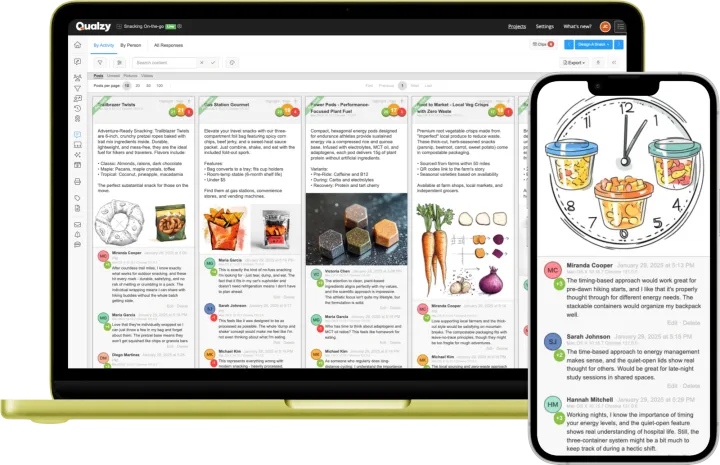
An ideation activity with participants' ideas and scores

Ideation

People submit ideas without seeing anyone else's, in text, video, audio or images. Once you've reviewed them, the voting round opens: everyone sees every idea and spends a limited pool of points on the ones they value, explaining every vote. The net score ranks the ideas for you, and you can comment on any idea to push the thinking further.

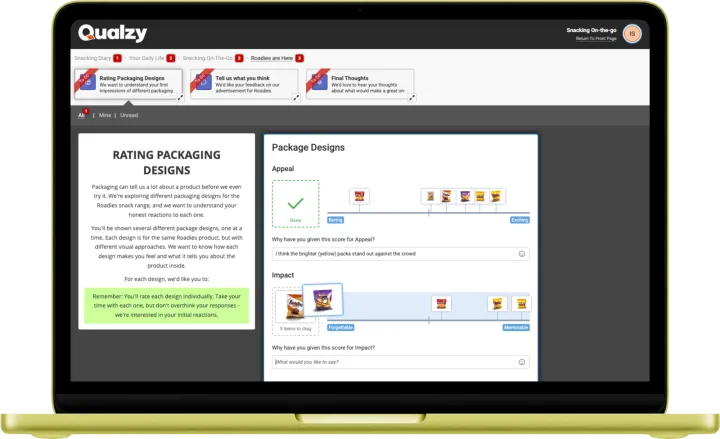
A card score activity with items rated on a scale

Card Score

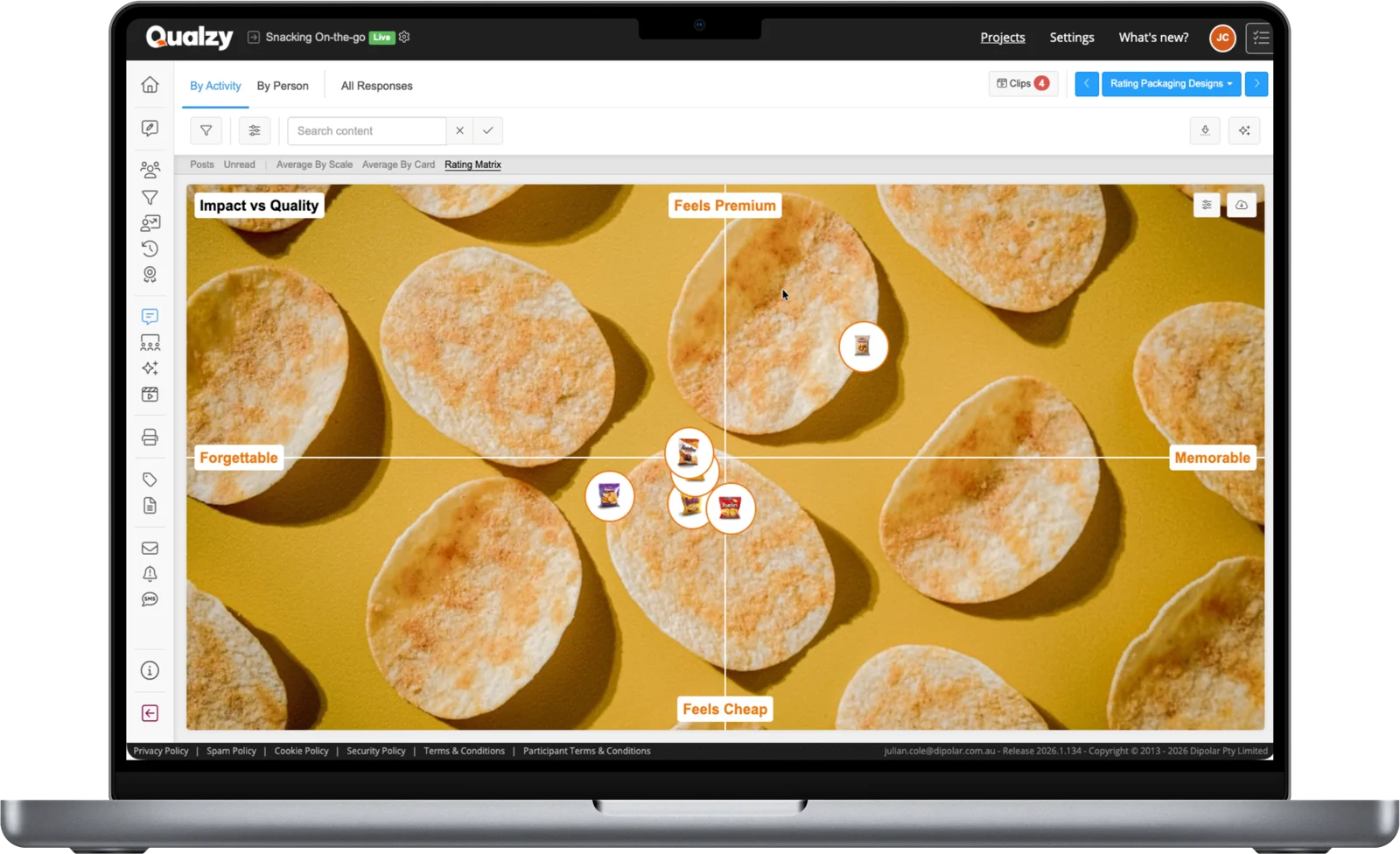
Score a set of ideas or concepts on appeal, relevance, uniqueness or any criteria you choose, with reasoning after each scale. Pick any two criteria and Qualzy plots every idea on a two-axis matrix.

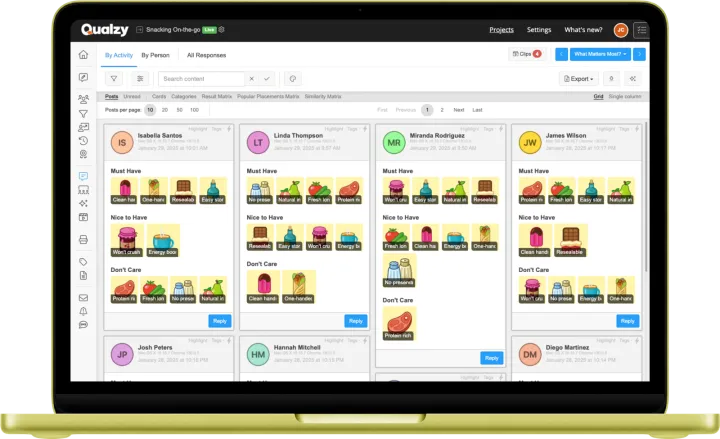
A card sort with items grouped into categories

Card Sort

Ask people to group the ideas that came out of a first round, or the needs behind them. It shows how they organise the territory in their heads, which is often different from how the brief does.

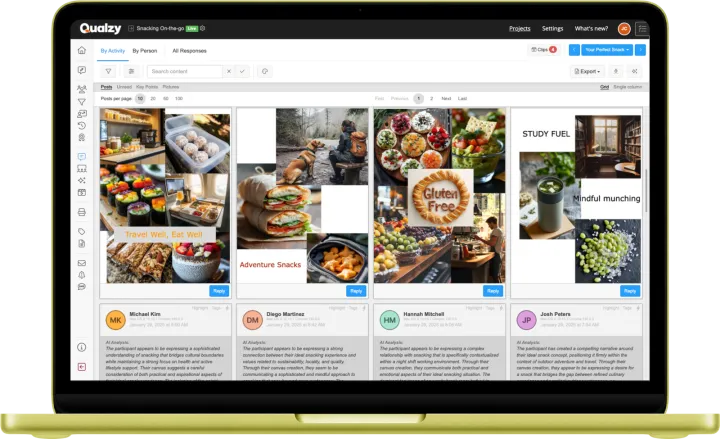
A participant's personal canvas collage of images and notes

Personal Canvas

For the ideas that are easier to show than to say. People build a mood board for a concept or for how they want a product to make them feel, with images, text and drawing, and explain what they've put there.

One way to run it

Four rounds, from a long list to a shortlist

Each round is an activity in the same project, so every round builds on the one before. Some studies need two rounds, some need six.

  1. Round 1Ideas, submitted blind

    Everyone adds their ideas without seeing anyone else's, in words, pictures, video or voice.

    You get the full range of thinking, including the odd ones.

  2. Round 2Everyone votes

    The voting round opens, and people spend a limited pool of points on the ideas they value, explaining every vote.

    You get a ranked long list.

  3. Round 3Scored and sorted

    The leading ideas go into a Card Score on appeal, relevance and uniqueness, and a Card Sort by the need each one meets.

    You get a matrix, and the territories behind it.

  4. Round 4Built on

    People develop the strongest few: what would make each one work in their lives, and what would stop them using it.

    You get a shortlist, with the reasoning attached.

How a study runs

Designed for the pace of innovation

A few days or a few weeks

A Qualzy Discussion can run for a few days or a few weeks. For a group you go back to as the product develops, a Qualzy Community keeps the same people on hand for each new round.

Several markets at once

Each market runs as its own project at the same time, in any of 30+ languages. Feeling Mutual have launched six markets at once this way. More on global research.

Customer stories

Innovation work on tight timelines

Feeling Mutual

Agile innovation research across 15+ countries

Tom Woodnutt runs innovation research for clients who develop and launch digital products to tight timelines. He uses Qualzy to capture behaviour as it happens, with in-the-moment video, photo diaries, screen recordings and concept tests with scoring, and has launched six markets at the same time.

  • 15+ countries
  • 6 markets launched at once

"Qualzy gives me peace of mind. It takes the stress away knowing that I have a technology platform that works really well, and support that is flexible enough to deal with the unexpected."

Tom Woodnutt, Founder, Feeling Mutual

Read the Feeling Mutual story
Ninth Seat

300+ projects for global consumer brands

Ninth Seat runs research for clients including Unilever, Nestlé and Mondelez, and Qualzy builds many of their projects for them. An intensive two-week project took the Qualzy team four or five hours to build.

"As soon as Qualzy began offering the service to build projects, we took it. It is a lifesaver. They have built really intensive two-week projects in just four or five hours that would have taken me a couple of days."

Dafydd Jones, Associate Director, Ninth Seat

Read the Ninth Seat story
From ideas to the debrief

A shortlist you can defend

  • Ranked output, automatically. Ideation net scores and Card Score means rank the options for you, with every vote and score explained.
  • Every idea summarised. Each submission is summarised as it arrives, with key points linked to the participant’s own words.
  • Questions about any idea. Use Maizy Chat to ask the whole dataset a question, such as what people liked most about one idea, during fieldwork or after it.
  • Themes once fieldwork closes. Build themes across the full dataset, with the quotes and clips that support each one.
A Card Score rating matrix in Qualzy, plotting concepts against two chosen criteria
Card Score results: pick any two criteria and every option is plotted against them.
FAQ

Common questions about innovation research

Why do people see each other's ideas only later?

So nobody anchors on the first idea they read. In Ideation, people submit their own ideas blind. The voting round opens once you've reviewed them, and then everyone sees and rates the full set.

Can Ideation run in the AI-moderated chat?

No. Ideation runs only in the forum, because people need to see and vote on each other's ideas, and so does screen recording. The other activities on this page work in the forum and in the AI-moderated chat.

Can we go back to the same people as the idea develops?

Yes. Run each round as a new activity in the same Discussion, or use a Qualzy Community if you'll be going back to them over months.

Can we add our own ideas to the mix?

Yes. Put your own concepts into a Card Score alongside the strongest ideas from the first round, and see how they compare on the same criteria.

15-minute Discovery Call

Tell us what you’re trying to invent

The problem, the audience and how far along the ideas are. We’ll suggest how many rounds you need and what each one should do.