Personal Canvas is a visual activity where participants build mood boards, collages, matrices or quadrant maps to show what a brand or idea means to them. It turns associations and feelings into images, capturing what people struggle to put into words, with their reasoning alongside.

How it works
Participants add images from their device, camera, or Qualzy's built-in image search, alongside text elements and stickers. They can resize, rotate, and layer images, draw directly onto the canvas, and annotate freely, creating a visual statement that reflects their own associations. No design skills required.
Researchers can configure the canvas as a free-form mood board, a structured matrix (for example, warm to cold, trusted to risky), a quadrant map, or a brand personality collage. The format guides the expression without constraining it.
Participants add labels, captions, and explanations to their canvas elements. The visual is always accompanied by the reasoning, so researchers get the image and the story behind it, with no collage left to interpret alone.
Participant experience
Participants open the canvas in their browser on any device. Adding an image is as simple as searching and clicking. They don't need to source or upload their own photos if they'd rather not.
Arranging and labelling is intuitive. Most participants enjoy it, a welcome change from the rating scales and open-text boxes they're used to.
Personal Canvas works in a Qualzy Discussion or a community, and participants can also complete it in the AI-moderated chat.
Participant taps their invitation link on any device: mobile, tablet, or desktop. No app to install.
Selects images from their device, camera, or the built-in search powered by Pixabay and Unsplash, thousands of options without leaving the platform.
Moves, resizes, and positions images on the canvas, building a visual that captures their associations and feelings.
Labels images and explains their choices, the reasoning that gives the visual its meaning.
The complete canvas, including all images and written annotations, is submitted for AI processing and researcher review.
Canvas examples
From brand mood boards to conceptual mind maps, no two canvases are the same.


AI analysis
The annotations participants add to their canvases are AI-processed the moment a submission arrives, turning written reasoning into structured, queryable insight across the whole project.
Summaries
The text annotations and captions participants add to their canvas are AI-summarised, giving researchers a quick read of the thinking behind each image choice without reading every word of every submission.
Key points
AI extracts key points from each participant's annotations, so the associations and emotional language that recur across dozens of canvases are easy to see.
Maizy Chat
Query across all canvas annotations at any point during or after fieldwork: "What brand associations appear most frequently?" or "How do participants describe luxury across different markets?"
Use cases
Brand perception is where the canvas earns its place. People often struggle to say what a brand means to them, but they can usually show you. Insights Exchange in Sydney use mood boards and positioning boards for their brand positioning research, and find them as effective online as in a focus group room.
Participants build a visual representation of how they see a brand: its values, its personality, its place in culture. It brings out associations and emotional territory that direct questions rarely reach.
Present participants with a creative or product concept and ask them to build a canvas that captures their emotional response. It gives you the feeling behind the response, the kind of depth a rating scale can't reach.
Place brands, products, or attributes onto a matrix to understand how the competitive set is perceived. Comparable across participants, so patterns are easy to see.
Ask participants to build "a day in the life" of a brand persona, or to create a mood board for "how you want to feel", techniques that access implicit attitudes beyond the reach of rational self-report.
Combine Personal Canvas with these for richer visual and associative research designs
Activity type
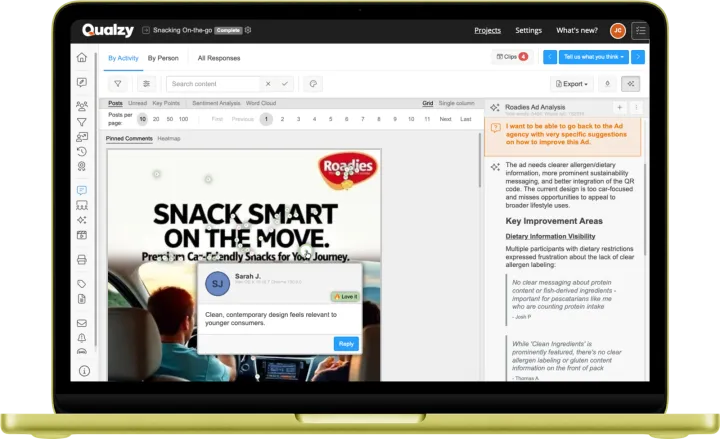
Pin Task
Annotate images with heat maps and pinned comments, precise visual markup on researcher-supplied stimuli.
Activity type
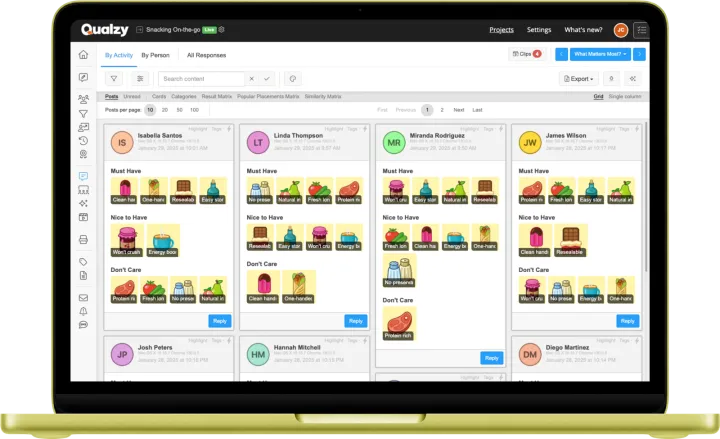
Card Sort
Organise items into categories visually, structured association mapping across the whole participant group.
Activity type
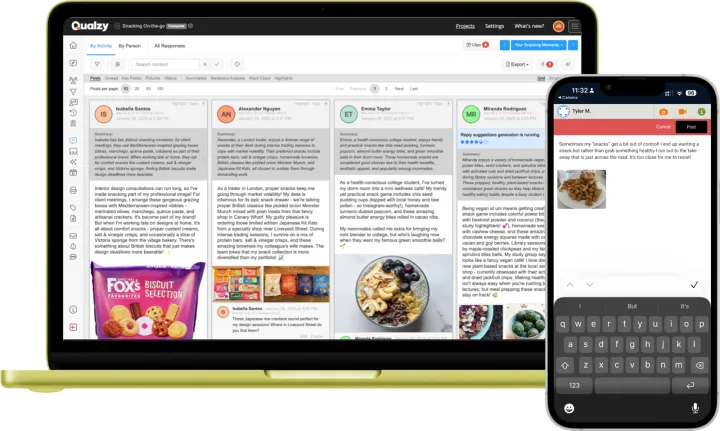
Social Posts
Combine text, images, video, and audio in one response, flexible multimedia expression in a social format.
15-minute Discovery Call
Tell us about your research. You'll have a clear picture of how Qualzy could work for you by the end of the call.
