Brand perception

What your brand means,
in their words and pictures

Brand perception research finds out what a brand means to people. People often struggle to say it but can usually show you, so Qualzy uses mood boards, positioning maps and in-the-moment posts to bring out the associations and feelings direct questions rarely reach, with the reasoning behind every one.

Examples of what you can research

Image, position and everyday presence

Most brand studies touch all three, and plenty go somewhere else entirely. Where you start depends on the question the business is asking.

Brand image

Personality and associations

Ask people to build a picture of how they see a brand: its values, its personality, its place in their lives. Projective tasks, such as a day in the life of the brand as a person, reach implicit attitudes that rational self-report misses.

Positioning

Where you sit against competitors

Place brands on a matrix, such as trusted to risky or warm to cold, or rate them on the attributes that matter. You see where each brand sits in people's minds, where the white space is and where a competitor is vulnerable.

In real life

The brand in everyday moments

What people say about a brand and how it shows up in their lives aren't always the same. Ask them to post when they notice it, use it or choose something else instead, and you see the brand as it's actually lived.

Projective tasks

Questions that get past the first answer

Ask people what a brand stands for and you'll hear its advertising played back. Projective tasks give them another way in, and because everyone answers on their own, every answer is their own.

Personification

If the brand walked into the room, who would it be? What are they wearing, and who are they talking to?

Shows you personality, status and warmth, in terms people find easy to describe.

The brand party

Every brand in the category is at the same party. Who's hosting, who's stuck in the kitchen and who left early?

Shows you where each brand sits next to the others, and why.

Obituary

The brand has closed down. Write its obituary. What will people miss, and what won't they?

Shows you what's genuinely distinctive, and what's at risk.

Mood board

Make a board of how the brand makes you feel, then one for its closest competitor.

Shows you the emotional territory, built in a Personal Canvas.

The activities

Tasks people can show you, not just tell you

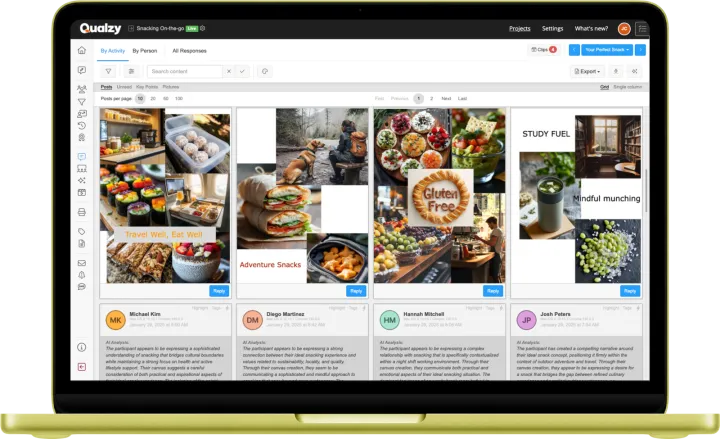
A participant's personal canvas collage of images and notes

Personal Canvas

People build a mood board, a brand personality collage or a positioning map, adding images from their own device or a built-in image search, plus text and drawing. Every element is labelled and explained, so you get the image and the story behind it. Set it up free-form, or as a matrix or quadrant that guides the expression without constraining it.

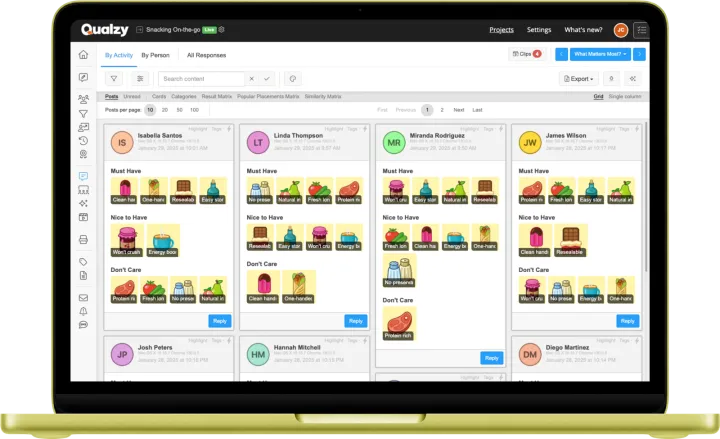
A card sort with items grouped into categories

Card Sort

Ask people to group brands, or brand attributes, the way they'd naturally put them together. It shows which brands they see as alike, and the categories they'd create themselves.

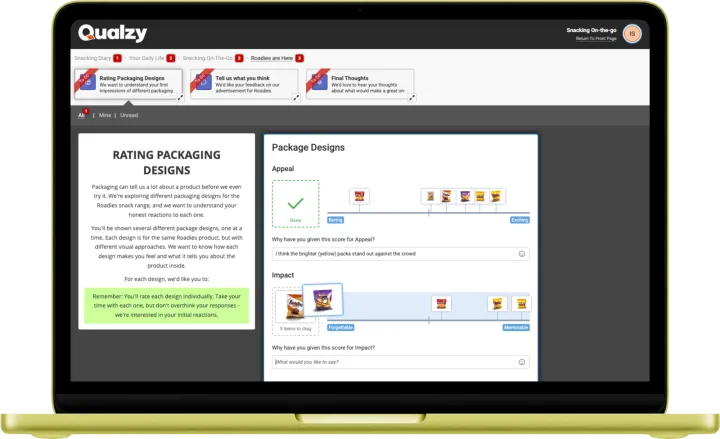
A card score activity with items rated on a scale

Card Score

Rate a set of brands on innovation, trust, value, quality or any attribute you choose, with reasoning after each scale. Pick any two attributes and every brand is plotted on a two-axis map.

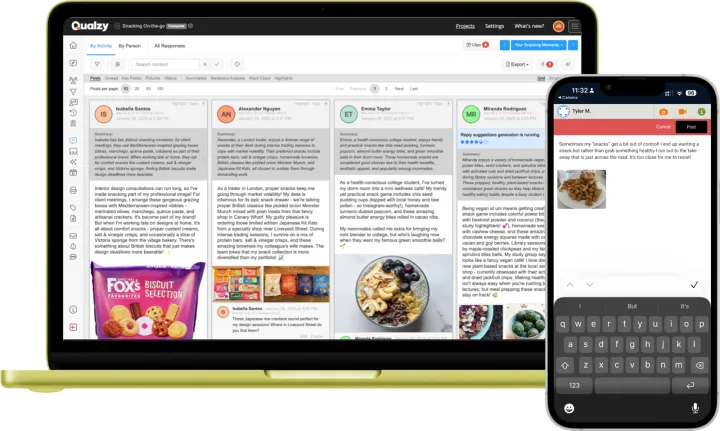
Participants' social posts with photos, and AI summaries above each one

Social Posts

Text, photos, video and voice notes in one response, posted from the moment the brand turns up: on the shelf, in an ad, at the point of choosing something else. Comments and replies can be switched on, so people build on each other's views.

Customer stories

Brands seen across countries, and in everyday life

Insights Exchange

Brand positioning, Perth to Auckland

Insights Exchange in Sydney runs brand positioning research across Australia and New Zealand on Qualzy, using mood boards, positioning boards and image-based activities. They find visual brand work as effective online as in a focus group room, without the cost of flying people to Perth and Brisbane.

"One of the most surprising things has been the level of depth and breadth you can get using a tool like Qualzy. There's so much richness you can get out of a community platform."

Nichola Quail, Founder, Insights Exchange

Read the Insights Exchange story
Flume

Everyday brand choices for grocery and FMCG brands

Flume runs online studies on Qualzy for grocery, food and drink brands, some lasting months, capturing how people choose, buy and talk about brands in their everyday lives.

  • 66,685 posts
  • 5,438 hours of engagement
Read the Flume story
How a study runs

As rich online as in the room

Visual tasks that work online

Mood boards and positioning boards work as well online as they do in a focus group room, and everyone completes their own.

A one-off study or a tracking community

Run a short Qualzy Discussion for a single brand study, or track how perceptions shift over months in a Qualzy Community.

Across a country, or several

Reach people across a whole country without the travel, or run each market as its own project at the same time, in any of 30+ languages. More on global research.

From canvases to the debrief

The pictures, and what they mean

  • Every annotation summarised. The labels and explanations people add to their canvases are summarised and broken into key points as they arrive.
  • Associations that recur. Key points make the associations and emotional language that come up across dozens of canvases easy to see.
  • Ask Maizy Chat. Ask which brand associations appear most often, or how people describe luxury, during fieldwork or after it.
  • Themes once fieldwork closes. Build themes across the full dataset, with the quotes and images that support each one.
A participant's Personal Canvas in Qualzy: a mood board of images with their labels and explanations
A Personal Canvas: the images a participant chose, with what each one means to them.
FAQ

What brand teams usually ask

Do participants need to find their own images?

No. They can use photos from their own device or camera, or pick from a built-in image search powered by Pixabay and Unsplash, without leaving the activity.

Can we compare brands side by side?

Yes. Card Score rates every brand on the attributes you choose and can plot any two of them against each other. Card Sort shows which brands people group together.

Can we track brand perception over time?

Yes. Run the same tasks in waves in a Qualzy Community, with the same people coming back, and compare how their views change.

Can Qualzy build the study for us?

Yes. Send us your discussion guide and our team builds the project, and we'll flag anything in the guide that might trip participants up before it goes live.

Can we use our own brand material as stimulus?

Yes. Upload logos, ads, packs or competitor material into a Card Score, Card Sort or Pin Task, so people react to the real thing.

15-minute Discovery Call

Tell us about your brand

The brand, its competitors and what you need to understand. We’ll talk through which tasks would get you there.