AI-moderated interviews work best when you know what a complete answer looks like: they probe vague replies consistently, at any hour, across many participants and time zones. They're weaker for sensitive topics, early exploratory work, expert interviews and anything that depends on group dynamics, where a human moderator or a live focus group is still the better choice.
That's the short version. The longer one depends on which kind of AI-moderated interview you mean, because the term now covers some quite different things.
There's more than one kind of AI-moderated interview
Most products sold as AI-moderated interviews run a single conversation, by voice or video, in one sitting. The AI asks a set of questions, follows up on the answers, and the interview ends when the conversation does.
Qualzy's version is a different shape. Many researchers would call it an AI-moderated interview, and that's fair, but it runs as a multi-day study: a Qualzy Discussion that participants complete as a chat over several days, with real activities such as card sorts, pin tasks, diaries and photo and video uploads. An AI moderator works to the goals you set for each question, and the researcher can step in and moderate at any point. We call it the AI-moderated chat.
The difference matters when you're judging fit. A one-sitting interview gets you what someone can tell you in a single conversation. A multi-day chat can also catch what they do on a Tuesday evening, what's in their fridge, and how they feel about a product after the third time they've used it. Most of what follows applies to both kinds, and I'll say where it doesn't.
Where AI moderation helps
Following up on every vague answer
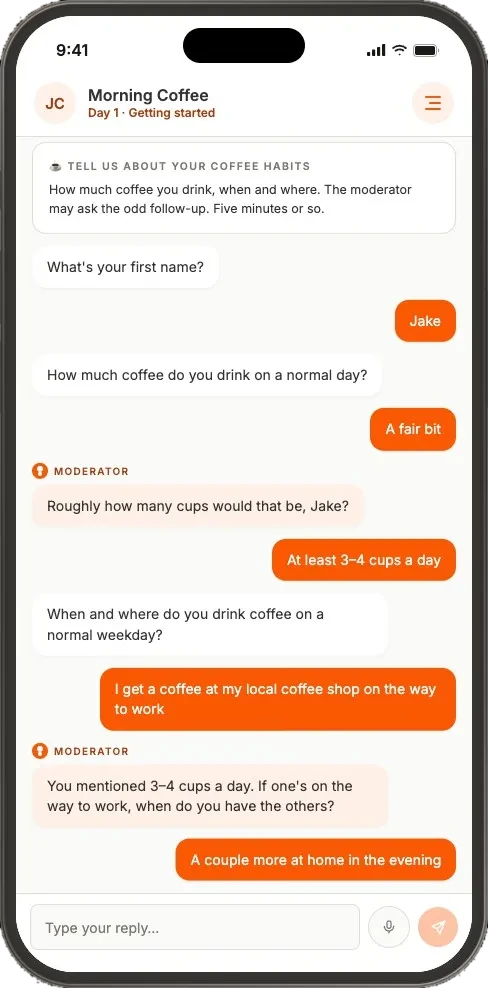
The most useful thing an AI moderator does is ordinary: it asks the follow-up. A participant says they drink “a fair bit” of coffee, and the moderator asks roughly how many cups that is. A human moderator would ask the same thing, if they were there. In an online study they usually aren't. The answer arrives at ten at night, you read it the next morning, and by the time your probe goes out the participant has moved on.
In the AI-moderated chat you write a goal for a question, saying what a complete answer contains and how hard to push for it, and the moderator follows up only towards that goal, while the participant is still in the conversation.
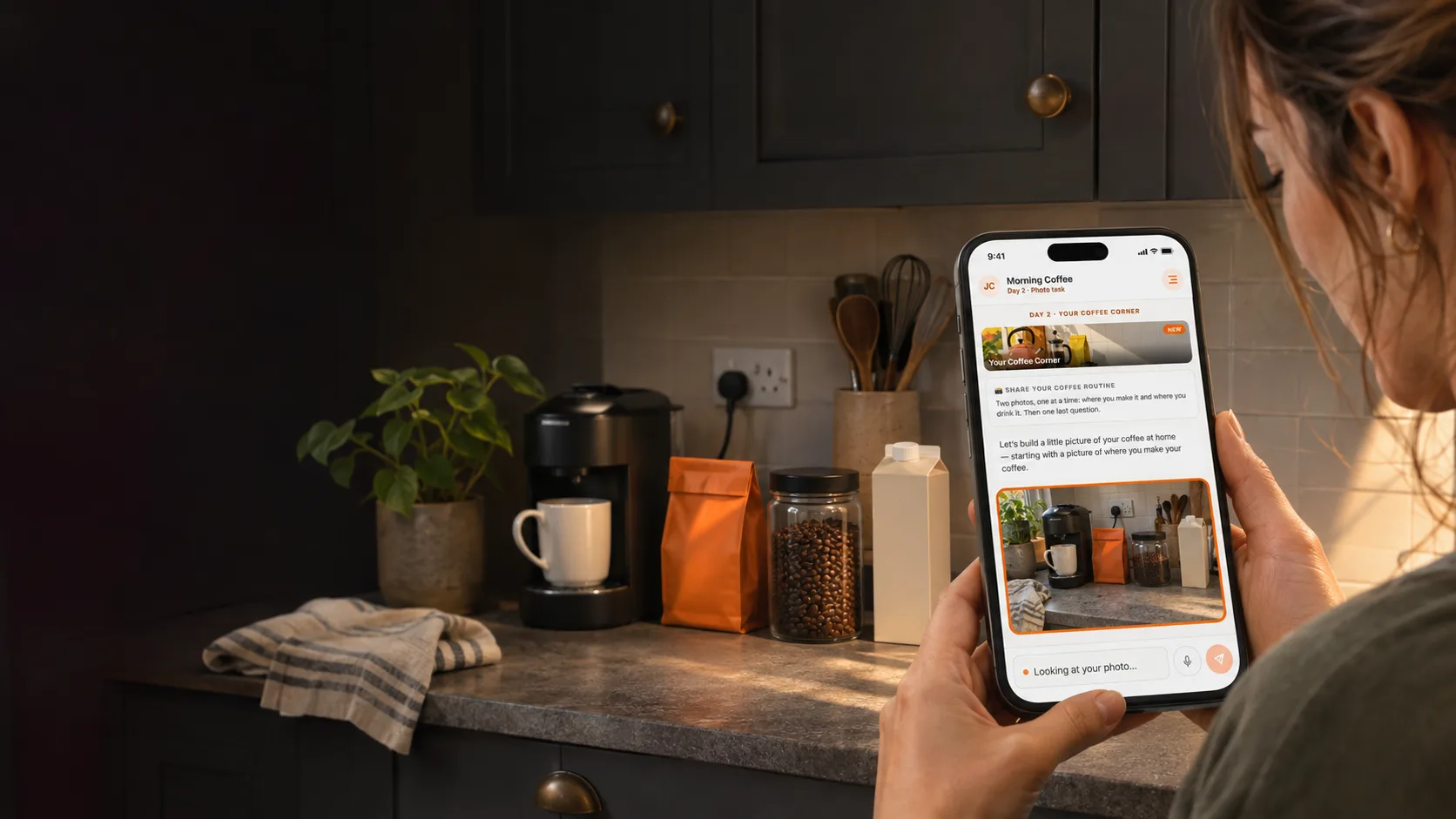
It works on more than text. The moderator looks at each photo as it arrives, so a picture of the wrong thing is picked up straight away, and it reads the transcript of every video, so a clip that only half answers the question gets a follow-up and a second clip.
Scale without thinning the probing
One moderator can give 20 people close attention over a three-day discussion. At 80, something gives, and it's usually the follow-ups. With AI moderation the 60th participant is probed as carefully as the first, so the extra sample actually gets the depth you designed the study for.
Time zones
A UK team running fieldwork in Australia or on the US West Coast spends a lot of it asleep. An AI moderator follows up in the participant's evening, when they're actually answering, and you read the result over breakfast with the gap already closed. For work across several countries, a Qualzy subscription lets one project hold as many markets and languages as you like; otherwise each market runs as its own project, all at the same time.
Languages
Every response in Qualzy is translated automatically if it's in another language, alongside a summary and key points, so you can follow a Spanish or German study as it comes in. That makes it practical to keep a close eye on markets where nobody on the team speaks the language, and to spot early when a question isn't landing.
Where a human moderator or a live group is better
There are plenty of studies where I wouldn't use AI moderation, or would use very little of it.
When you don't yet know what you're looking for
An AI moderator works to the goals you give it. If you can't write down what a complete answer looks like, because the point of the research is to find out what matters, it has nothing to aim at. Early exploratory work, where the best moments come from following something unexpected, needs a researcher's curiosity. Run it with a human moderator, or with the AI on a light touch and you reading every day.
Sensitive subjects
Health, money worries, bereavement, research with young people. A good moderator knows when not to push, when to let a short answer stand, and when a kind word should come before the next question. In the AI-moderated chat you decide where the AI takes part, question by question, and that includes not using it at all. For some projects that's the right call.
Experts and senior stakeholders
A procurement director or a consultant cardiologist expects to talk to someone who understands their world, and the conversation often goes somewhere the guide didn't plan for. These are usually live interviews, run by a researcher who can earn the right to ask the harder question.
Anything that depends on the group
Focus groups exist because people react to each other: a disagreement, a shared joke, a view that only surfaces once someone else has said it first. A voice or video AI interview is one-to-one by design. The AI-moderated chat has a feed where participants see and respond to each other's posts, and where your own probes appear, which brings some of that back over several days. It still isn't a live group. For real-time group dynamics, and for clients who want to watch them happen from a backroom, run focus groups in Qualzy Live.
Ideation
One practical limit in Qualzy: every activity type works in the chat except ideation. If your study needs participants building on each other's ideas, run that part as a forum.
The worries researchers raise
Researchers who've tried AI interviews tend to come back with the same three complaints. The probing was shallow, so a superficial answer was accepted and the conversation moved on. The pitch was a big saving in exchange for a drop in quality that nobody wanted to measure. And the tools seemed to have been designed by software developers with little feel for how a researcher gets a thoughtful answer.
They're fair complaints, and they're the right questions to ask of any tool, ours included. Can you control what counts as a complete answer and how hard it pushes? Can you read every response yourself and step in? What does it do to the cost of the study, and what are you giving up in return?
In the AI-moderated chat you set the goal and the level of follow-up for each question, you can moderate alongside the AI whenever you like, and it costs nothing extra on a Qualzy Discussion. Every response still gets the same AI analysis as any other: a summary and key points as it arrives, Maizy Chat to query the data whenever you want, and themes once fieldwork closes. The AI can run in your project's home region through Amazon Bedrock, and nothing participants say is used to train AI models.
Getting good results from AI moderation
- Write goals the way you'd write probes. “Make sure they've said roughly how many cups a day. If they have, accept it and move on.” Specific goals produce specific follow-ups. Vague goals produce “can you tell me more?”, which participants soon tire of.
- Set how hard to push, question by question. Push for a number. Go gently on a feeling.
- Take the study yourself first. Give a few deliberately poor answers and see what the moderator does with them.
- Read the first day properly. Check the follow-ups are landing the way you meant, and step in yourself where they aren't.
- Save your own probes for the interesting answers. Let the AI close the routine gaps and spend your time on the responses that surprise you.
Using both in one project
The choice isn't always one or the other. A design I like: a few days of AI-moderated chat with a larger sample to cover the ground, with photos and video from people's own homes, then live interviews or a couple of groups with the participants who said the most interesting things. In Qualzy the live sessions sit in the same project as the chat, so there's no re-recruiting, and the two are analysed together. The chat does the breadth and the consistent probing. The researcher does the conversations that need a person.