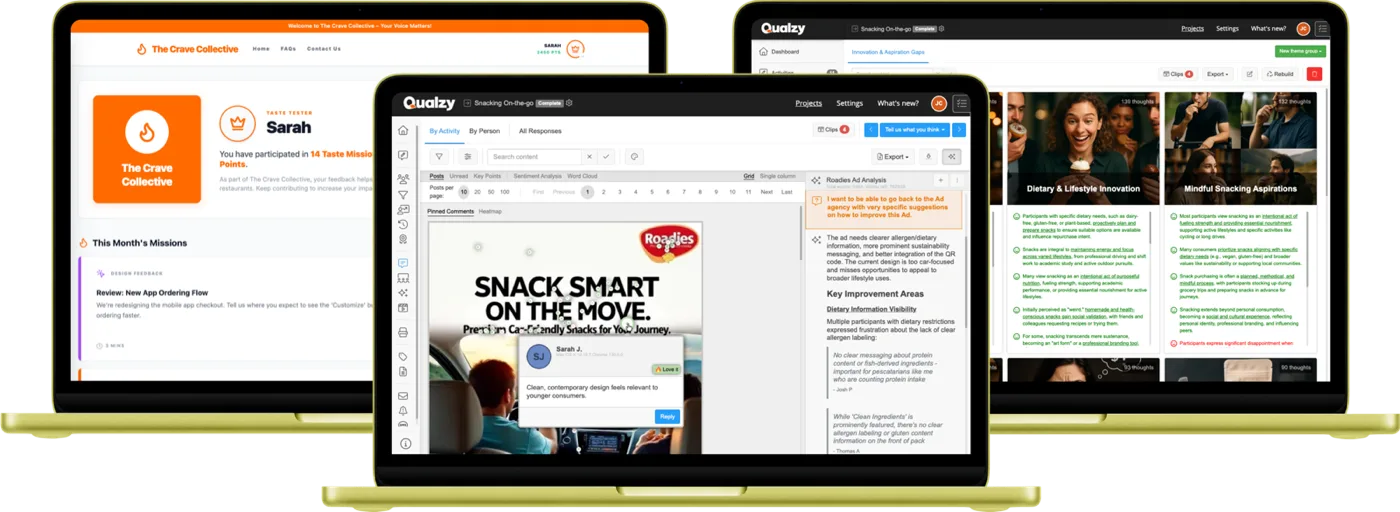
Asynchronous qualitative research is qual where participants answer in their own time instead of meeting a moderator at a set time. It runs online over days, weeks or months, as discussions, diaries, bulletin boards or communities, using text, photos and video. The researcher moderates as responses arrive, probing and following up between participants' visits.
You'll also hear it called online qual, async qual or, in older briefs, bulletin boards. Whatever the label, the idea is the same: spread the conversation out, and let people take part from their own lives.
How async differs from live research
In a live interview or focus group, everyone is there at once and the conversation happens in real time. In an async study it's spread out. A participant might answer three questions over breakfast, upload a video of their evening routine, and reply to your follow-up the next day. You read, probe and steer as it comes in.
That changes what you get back. Answers are more considered, because people have time to think. Behaviour is captured close to when it happens, in the kitchen, the shop or the car park, instead of being recalled in a viewing facility a week later. And everybody gets heard.
What you give up is the energy of a live conversation: the quick back-and-forth, the follow-up that lands in the same breath, people sparking off each other in the moment. Async also needs steady moderation over several days instead of one concentrated session, and some participants drift if the study asks too much of them.
The main formats
Most async projects take one of five shapes. The lengths below are typical, and you open and close fieldwork when it suits the project.
Pre- and post-tasks: one to three days
Short tasks that sit around live fieldwork. A few questions, a photo and a short video before an interview or group mean people arrive warmed up and you arrive knowing them. A post-task catches reactions on the day, before memory tidies them up. Discovery Research run many of their Qualzy projects as pre-tasks ahead of in-person groups and IDIs:
We used to ask for input in pre-tasks and get them to email things. Now it is all captured in one place inside Qualzy.
Hamish Kynoch, Head of Qualitative Research, Discovery Research
Quick discussions: three to five days
A focused discussion around one question or one piece of stimulus. It's long enough for considered answers and short enough to report back within the week, which is why concept tests, ad reactions and creative reviews often run at this length.
Diaries: one to four weeks
Follow people through a real experience while it's happening: a product trial at home, a run of shopping trips, the first month with a new energy supplier. This is where async does something live research can't, because you hear how it felt at the time, which is often different from how people remember it afterwards. Our guide to online diary studies covers how to design one.
Bulletin boards: up to a month
A moderated discussion that runs over days or weeks, where participants answer in their own time, read each other's posts and build on them. Boards suit topics you want to explore in depth with a group, especially when the people you need are hard to get into one room at one time.
Communities: months or years
The same people, coming back for wave after wave of activities. A community suits an organisation with a steady flow of questions: you recruit and profile people once, then go back to them whenever a new question comes up. Mustard Research's community for Transport for West Midlands has been running since 2020. For more, see what an MROC is and what a community costs.
In long term communities like this I really feel we are using Qualzy in the best possible way.
Anthony Shephard-Williams, Director, Mustard Research
In Qualzy, anything measured in days or weeks is a Qualzy Discussion, and research with the same people over months is Qualzy Community.
What participants actually do
Async qual is often described as an online forum, which undersells it. A good study mixes open questions with tasks: photo and video uploads, card sorts and card scores, pin tasks on an advert or a pack, a personal canvas, diary entries repeated over days, narrated screen recordings, social-style posts and ideation. Varied tasks keep people interested and give you different kinds of evidence for the same question.
Participants take part in a web browser on any device, with nothing to install. In a Qualzy Discussion they can take part in one of three ways: as a forum, the way online qual has long worked; as a chat that takes them through the activities step by step; or as an AI-moderated chat, where an AI moderator follows up on vague answers against goals you set. If you're weighing up that last option, we've written about when AI-moderated interviews work, and when they don't.
Running an async study well
- Plan the days. Give each day a theme and keep it to about 20 minutes of effort. Tell people at the start what's coming and when the study closes.
- Moderate on a rhythm. Check in at least twice a day: in the morning to probe yesterday's answers, and in the evening, when a lot of people post. A thoughtful follow-up tells participants someone is reading, and in my experience they write more the next day.
- Ask for evidence. A photo of the cupboard says more than a description of it. A one-minute video often says more than both.
- Decide what's mandatory. Mark the questions you can't analyse without, so a missing answer gets chased during fieldwork instead of discovered at the end.
- Let the client watch. Clients can follow responses as they arrive, which keeps them close to the project and makes the debrief easier.
Combining async and live in one project
The strongest designs often use both. A common pattern:
- A pre-task or a short discussion with everyone, to cover the ground and collect photos and video from their lives.
- Live interviews or focus groups with the people whose answers raised the most interesting questions, drawn from the participants you already have.
- A short post-task to catch reactions once people have had time to think, or to test something the groups threw up.
Run these as separate studies on separate tools and you end up with three datasets, two rounds of recruitment and a lot of copying and pasting. In Qualzy, live sessions in Qualzy Live sit inside the same project as your discussions and diaries. You can interview your best participants at the end of a study with no re-recruiting, and analyse the live sessions and the online responses together, with clips from both side by side. For the live half, our guide on how to run an online focus group covers the practical detail.
Analysing async data
Async studies produce a lot. A quick discussion with 50 people and a handful of tasks each can easily run to several hundred posts, photos and videos. That volume used to be the strongest argument against the method. Hamish Kynoch again:
If you have 50 people and you have seven tasks for each, it's incredibly hard to analyse all that manually, but we can now.
Hamish Kynoch, Head of Qualitative Research, Discovery Research
In Qualzy every response is processed as it arrives: translated if it's in another language, summarised, and turned into key points with the verbatims behind them. Every video is transcribed, so its key points link to timestamped clips you can build into a clip reel. Maizy Chat lets you ask questions of the whole dataset at any point during or after fieldwork, and once fieldwork closes, theme analysis builds themes from the key points, with the supporting quotes and clips. Every finding links back to what a participant actually said, so you can check it. There's more on how this works on our AI for qualitative research page.
When async isn't the right choice
Async is a poor fit when you need an answer by tomorrow, when the point is to watch people react to each other in real time, or when you're talking to senior people who'll give you an hour but won't log in three days running. Those are jobs for live interviews and groups. And when a project needs both kinds of conversation, it's usually better to run them together than to choose.